
Odoo and Zoho suit different businesses. Zoho Books fits UAE SMEs that need accounting, invoicing and VAT filing and little else. Odoo fits businesses running inventory, manufacturing, projects or multi-entity structures across free zone and mainland, where accounting is one module among several. The deciding factor is operational complexity, not company size.
Most Odoo versus Zoho comparisons compare the wrong things. They line up feature tables from two products that are not in the same category, and the finance manager reading them ends up choosing on price — then discovering in month four that the cheaper option cannot do the one thing her business actually needed.
The timing makes this worse. Compliance is pulling ERP evaluation forward across UAE SMEs. Businesses that would have reviewed their systems in 2028 are reviewing them now, and they are doing it under deadline pressure rather than on their own schedule. That is a bad state to make a five-year decision in, particularly when quotes for the same scope arrive varying tenfold with no explanation of what moved them.
This article gives you the three-year cost at three real user counts with the drivers named, what each platform does with a mainland and free zone structure, Arabic invoicing and multi-currency, where Odoo loses, and a routing table that tells you which business profile should choose which platform.
What's the actual difference between Odoo and Zoho?
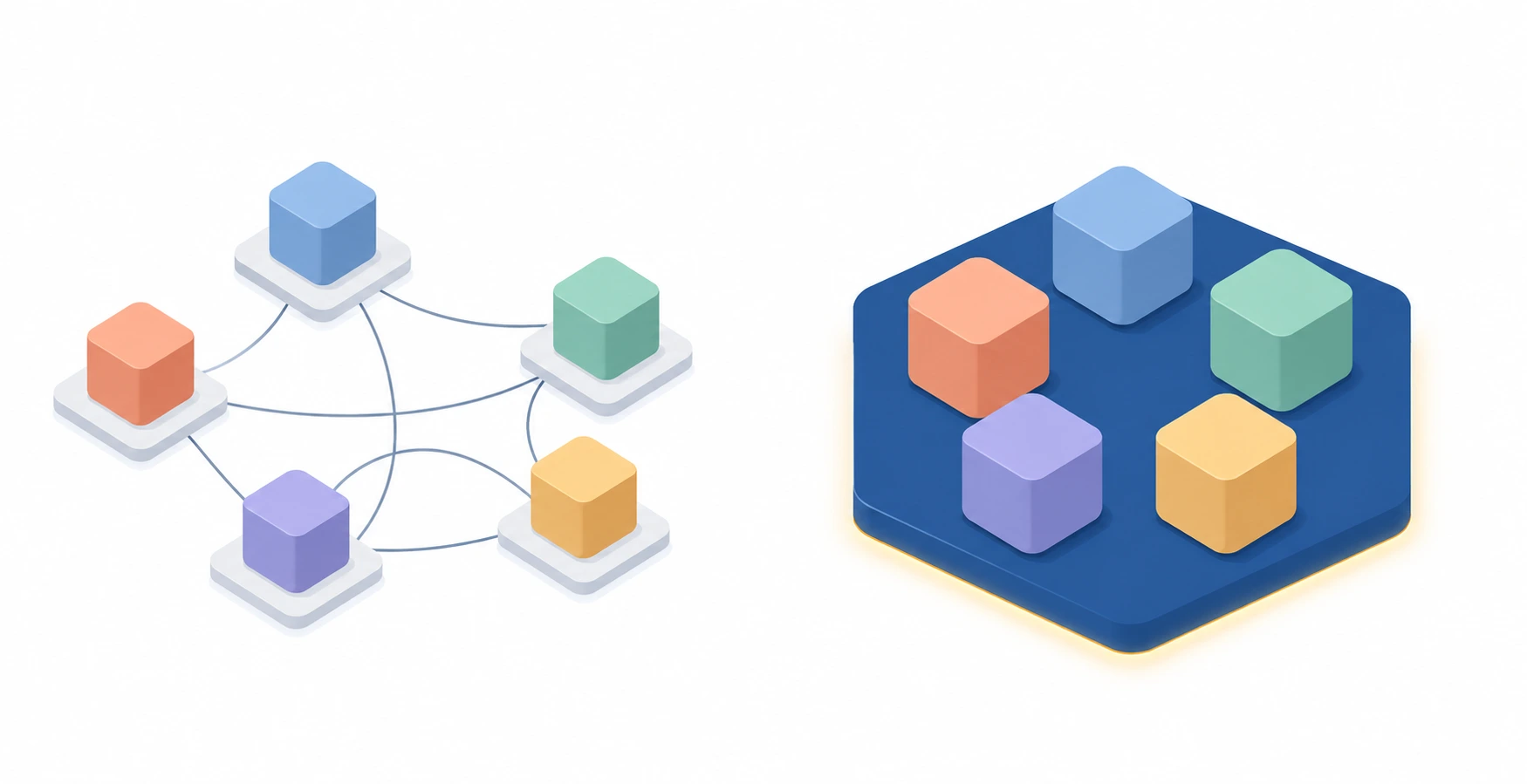
That distinction sounds academic until you watch it play out in a warehouse. In an integrated platform, your storekeeper confirms a delivery, stock moves, the customer invoice becomes available, and the journal entry posts — one action, one data set, nobody re-keying anything.
In an application-plus-integrations model, the delivery happens in one system, the invoice in another, and a sync keeps them roughly in step. Roughly is the operative word, and reconciling the gap is somebody's job every month.
Zoho Books, Zoho One or Zoho CRM — which are you comparing?
"Zoho" is not one product. Zoho Books is the accounting application. Zoho One is the bundle of business applications licensed per employee. Zoho CRM is a separate product with its own comparison against Odoo CRM. This article compares Zoho Books and Zoho One against Odoo. Most published comparisons blur all three, which is why their conclusions do not survive contact with a real requirement.
Zoho One genuinely narrows the breadth gap. You get inventory, CRM, projects, HR and expenses in the bundle. What you do not get is a single database underneath them — they are separate applications that integrate well with each other, which is a meaningfully different thing from modules sharing one data model.
CAPABILITY MATRIX
Capability | Zoho Books | Zoho One | Odoo |
|---|---|---|---|
Accounting & UAE VAT | Platform-wide | Native | Native |
Inventory |
Basic | Separate app | Native Module |
Manufacturing / assembly | Not available | Limited | Native Module |
Project costing | Not available | Separate app | Native Module |
POS | Not available | Separate app | Native Module |
HR & payroll | Not available | Separate app | Native Module |
E-commerce | Not available | Separate app | Native Module |
CRM | Not available | Separate app | Native Module |
Custom fields & workflows | Limited | Per app | Native Module |
The category difference determines everything downstream: what implementation costs, how long it takes, and the ceiling you eventually hit. Which brings us to the question you actually opened this article for.
Which is cheaper, Odoo or Zoho?
QUICK ANSWER
It depends which tier you compare. Zoho Books is cheaper than Odoo Standard because it is priced per organisation rather than per user. But at the platform tier the order reverses: Odoo Custom is AED 899 per user per year against Zoho One at AED 1,632 per employee, and Zoho charges more to implement.
Most comparisons get this wrong in the same way: they price Zoho Books against Odoo and call it a result. Zoho Books is one application. Odoo Standard includes every Odoo app at its per-user price. Comparing those two answers a question nobody asked.
Compare the tiers that actually correspond and a different picture appears. Below are the three cost components that matter — subscription, implementation and ongoing support — as each vendor publishes them.
WHAT EACH PLATFORM COSTS IN THE UAE
Cost component | Zoho Books | Zoho One | Odoo |
|---|---|---|---|
Charged per | Organisation Seats included per plan | Employee or user All Employee covers everyone on payroll | User Backend users only; portal users free |
Subscription (per year, billed annually) | AED 720 Standard (3 users) AED 1,080 Professional (5) AED 1,440 Premium (10) AED 3,360 Elite (10) Extra seats AED 96 each. | AED 1,632 per employee (All Employee), AED 3,960 per user (Flexible User) 50+ apps | AED 782 per user — Standard, AED 899 per user — Custom all apps at either tier, One App Free — unlimited users |
Implementation (vendor service) | NA | AED 734 per hour Jumpstart, 10-hour minimum | AED 1,811 – 78,041 Success Packs, 4–200 hours |
Support, hosting, maintenance, upgrades | Included in plan | Included in subscription | Included in subscription |
Vendor pricing only — partner rates vary and are not included. Prices exclude VAT and assume annual billing. Billed monthly instead, Odoo costs 25% more; Zoho Books costs 15% to 43% more depending on plan. Sourced 12 August 2026 from odoo.com/pricing, odoo.com/pricing-packs, zoho.com/ae/books/pricing, zoho.com/one/pricing and zoho.com/jumpstart. Odoo figures from a UAE quotation dated 12 August 2026, one user, one year, converted at the pegged rate of AED 3.6725. Note the basis differs: Zoho Books is priced per organisation with seats included, so it does not scale per user the way the other two do.
Compare like with like
Read the table across the right pairs. Zoho Books sits opposite Odoo Standard on Odoo Online — the entry tier, cloud-hosted, no customisation. Zoho One sits opposite Odoo Custom on Odoo.sh — the platform tier, with customisation, multi-company and API access.
Read that way, two things become clear. Zoho Books is cheaper than Odoo at the entry tier, because it is priced per organisation — AED 1,440 a year covers ten users on Premium, where ten Odoo Standard users cost AED 7,820. But Zoho Books is one application, and Odoo Standard includes every Odoo app at that price.
At the platform tier the order reverses. Odoo Custom is AED 899 per user per year. Zoho One is AED 1,632 per employee on the All Employee plan, or AED 3,960 per user on Flexible User pricing. Odoo Custom costs a little over half the first and under a quarter of the second.
In rough order of impact: how many users you license, how much historical data you migrate and what condition it is in, how much of your process you customise rather than adapt, whether you host on Odoo Online, Odoo.sh or private cloud, and how many languages you train in.
Compared platform to platform, Odoo is the cheaper subscription — not the more expensive one.
One practical note before you compare quotes. Every figure above assumes annual billing. Pay monthly and Odoo costs 25% more; Zoho Books costs between 15% and 43% more depending on the plan. Quotes presented on different billing periods are not comparable, and that is the most common reason two numbers for the same scope look further apart than they are.
Implementation widens the same gap. Zoho's own Jumpstart service charges AED 734 an hour with a ten-hour minimum. Odoo's Success Packs work out at roughly AED 390 to 529 an hour depending on pack size — so Zoho charges around 1.6 to 1.9 times Odoo to implement.
One gap worth naming: Jumpstart covers CRM, Bigin, Desk, CRM Plus and Backstage. Zoho publishes no implementation rate for Zoho Books at all. Simple deployments are commonly self-implemented; anything involving multi-currency, inventory or migration means a partner. The absence of a published rate is itself information.
The licensing basis matters more than the rate
Zoho One's All Employee plan requires a licence for every employee on your payroll. Odoo charges only for users who access the backend — portal, customer and supplier accounts are free.
For a UAE trading, contracting or logistics business that is the dominant variable. A forty-person company with twelve desk users licenses forty Zoho One seats and twelve Odoo seats. Zoho's alternative, Flexible User Pricing, lets you license only the people who need it, at roughly two and a half times the per-seat rate.
Where Odoo's pricing model is genuinely unusual
One price covers every app. A sole trader can run Odoo's One App Free plan — one application, unlimited users, no cost — or pay for a single Standard user and get the full application set: accounting, CRM, inventory, projects, POS, website. Adding people later means adding subscriptions, not migrating platforms.
That gives Odoo an unusually wide span. The same product serves a one-person consultancy and a forty-person multi-entity group, and the path between them is a billing change rather than a replacement project. Very little else in this market does that.
Two honest limits on it. The free plan is one app only — its dependencies come with it, which makes it a real option for invoicing but not a route to running your whole business free. And installing Odoo Studio or adding a second company moves you automatically to the Custom plan, at roughly double Standard. Budget for the tier you will be on in year two, not the one you start on.
Why Odoo Custom matters if you run more than one entity
Multi-company is not in Odoo's Standard plan. Multi-company, Odoo Studio and the External API are Custom-plan features. If you run a mainland company and a free zone entity, you are on Custom, and your subscription roughly doubles. This is the most commonly missed line in an Odoo budget, and it lands on exactly the businesses in this audience most likely to need it.
What drives an implementation quote up
In rough order of impact: how many users you license, how much historical data you migrate and what condition it is in, how much of your process you customise rather than adapt, whether you host on Odoo Online, Odoo.sh or private cloud, and how many languages you train in.
A quote that gives you a range without naming its drivers is a lead-capture device wearing a guide costume.
One thing to ask whoever quotes you. Odoo's own Success Packs are boxed by hours — Starter buys 4 consultant hours, Pro buys 200 — which puts the risk of a longer project on you. A fixed-price scope puts it on the implementer. Ask which of the two you are being offered, and what happens when the hours run out.
Not sure which band you fall into?
Fixed-price scoping gives you a written cost and scope you keep, whether or not you engage us.
Is Zoho Books enough for a UAE company?
This is the section most Odoo partners leave out. It is in ours because the alternative — selling an implementation to a business that does not need one — is exactly the failure mode this market has trained you to expect.
One correction to the usual framing, though. The barrier for a small business is not Odoo's subscription — a sole trader can run one Odoo app free, or pay AED 782 a year for a single user and get the whole suite. The barrier is setup effort and ongoing administration, and that is a real barrier, which is why the cases below still stand.
Three cases where we'd tell you to stay on Zoho
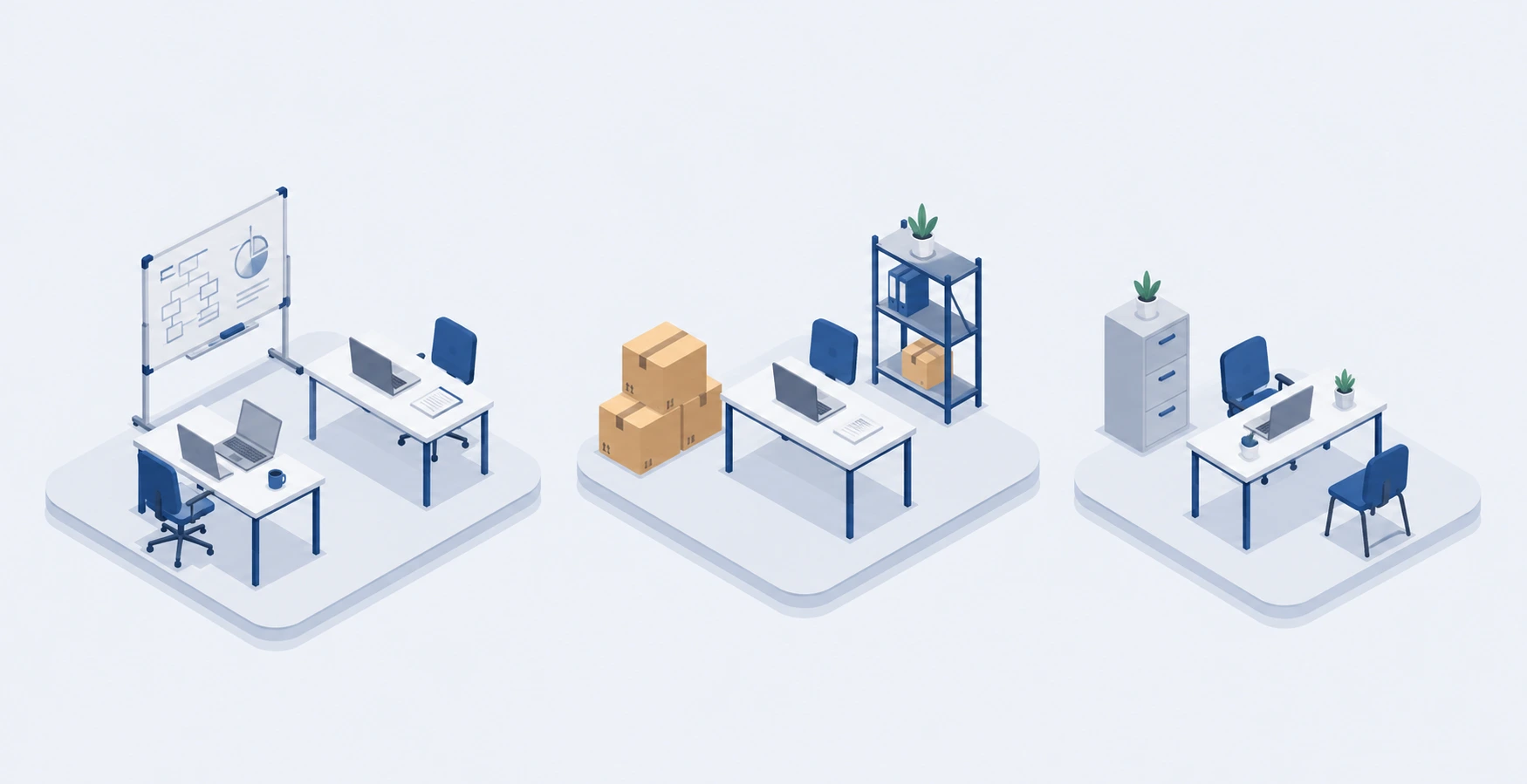
PROFILE 01
Single-entity services, no inventory
Consultancies, agencies, clinics, training providers. Your cost of sale is people. Odoo would run it, but the modules you'd be configuring are ones you would never open.
PROFILE 03
No dedicated finance headcount
The decisive one. Odoo rewards a finance manager who configures it properly. If accounts are part-time or handled by a monthly visitor, no subscription price makes it the right call.
PROFILE 02
Traders in finished goods, simple stock
One warehouse, no assembly, no batch or serial tracking. If your stock question is "how many do I have," basic inventory answers it.
There are things Zoho does better than Odoo, not merely adequately. Time from purchase to first invoice is one. Day-to-day administrative burden is another. And the interface is operable by someone who is not an accountant, which matters more than it sounds when the person raising invoices is a sales coordinator.
The Owner-Operator's stated fear is buying a system his team abandons in six months. He has either lived that or watched a peer live it. An over-specified ERP is the single most reliable way to produce that outcome.
When does Odoo become the better choice?
Odoo becomes the better choice when accounting stops being the main job. Multi-entity structures, real inventory with batch or serial tracking, manufacturing or assembly, project costing, and workflows that need to enforce approvals across departments are where an integrated platform earns its higher cost.
The trigger is rarely a feature. It is an event, and there are five that recur across UAE SMEs.
The five signals you've outgrown an accounting package
The event | What breaks |
|---|---|
You open a second entity | Free zone alongside mainland. Consolidation and inter-company entries move into spreadsheets — and those spreadsheets become what your auditor asks about. |
Someone reconciles stock in Excel | Not once. Every month. The clearest single signal on this list, and usually visible for a year before anyone acts on it. |
A customer demands traceability | Batch or serial tracking, expiry dates, certificates per lot. Arrives from one enterprise customer or one government tender, and is not negotiable. |
Nobody can produce margin per job | Revenue is per project; cost is scattered across payroll, procurement and subcontractors. Gross margin becomes an estimate assembled two months late. |
Approvals live in WhatsApp | Purchase authorisation, credit limits and discount thresholds enforced socially rather than systemically. Works until the person enforcing them leaves. |
One honest caveat on customisation. Odoo will let you reshape almost anything, and every customisation is something to carry through future version upgrades. Deep customisation is a real cost with a real tail, and a partner who does not raise it before you sign is not going to raise it afterwards either.
And one thing Odoo does not fix: your master data. Duplicate customer records, TRNs entered inconsistently across three fields, no product naming discipline, numbering gaps nobody has explained. Every SME migrating off an accounting package arrives with some of this. No platform choice resolves it — cleanup does, and it needs doing whichever way this decision goes.
How do Odoo and Zoho handle UAE-specific requirements?
QUICK ANSWER
UAE CAPABILITY MATRIX
UAE requirement | Zoho Books | Zoho One | Odoo |
|---|---|---|---|
VAT return preparation | Native |
Native |
Native |
TRN capture & validation |
Native |
Native |
Configuration |
Multi-entity consolidation |
Limited |
Limited |
Native |
Multi-currency revaluation |
Native |
Native |
Native |
Arabic / bilingual invoice |
Template-level | Template-level |
Localisation + template |
WPS payroll file | Not available | Via Zoho Payroll | Module / partner work |
Corporate tax reporting | Configuration |
Configuration |
Configuration |
Arabic and bilingual invoicing: what each produces
Arabic invoicing deserves more attention than it gets. It is on the requirement list for most UAE businesses selling to government entities or large local customers, and the published comparison content covers it almost nowhere.
The honest position on Odoo here: bilingual invoicing works well, and it is not a checkbox. You are configuring a report template with right-to-left layout, dual-language field labels, and correct rendering of Arabic customer names pulled from the partner record. It is a day of work done properly, and it is done once. Zoho handles the same requirement at template level with less flexibility in the layout.
Free zone and mainland in one system
This is the sharpest dividing line for this audience. If you operate both, you need entity-level books, inter-company transactions, and consolidated reporting that your auditor accepts. Odoo does this natively. Zoho Books handles multiple organisations, but consolidation across them is materially more manual.
One last practical note. Your finance and warehouse teams may operate across English, Arabic, Hindi, Malayalam, Urdu and Tagalog. Both platforms support multilingual interfaces; the real question is which one your team will be trained on, in which language, by whom. That is an implementation question, not a software question — and it belongs in your evaluation anyway.
Do you need an ASP with either platform?
The role split is worth stating plainly, because it is blurred constantly in this market.
Neither Odoo nor Zoho transmits to the FTA.
Both connect to an ASP — Odoo through its API and connector layer, Zoho through its own integration options — and in both cases someone still has to make sure the data leaving your system is clean and complete enough to pass validation. That part is not a licensing question.
Your dates, your scope, and how to choose between accredited providers are not Odoo-specific. We cover those on Foxedg.Your dates, your scope, and how to choose between accredited providers are not Odoo-specific. We cover those on Foxedg.
How hard is it to migrate from Zoho to Odoo?
Migrating from Zoho to Odoo is a data exercise, not a technical one. Chart of accounts, customers, suppliers, products and open balances move without difficulty. The work sits in cleaning duplicate records and inconsistent TRNs before migration, and in deciding how much transaction history to carry across.
What moves, what needs mapping, what doesn't move
Category | What's in it |
|---|---|
Moves cleanly | Customers, suppliers, products, chart of accounts, tax codes, opening balances. Structured, exports well, straightforward field mapping. |
Needs mapping | Anything the two systems model differently — tax treatments, payment terms, analytic or cost-centre structures, and custom fields you added years ago and half-forgot. |
Doesn't move | Attachments in bulk, the internal audit trail, historical document PDFs in original form. Plan read-only access to the old account for a defined period. |
The history decision is the one that drives cost. Full transaction history means more data, more validation and more time. Opening balances plus a clean cutover date means a faster project and a two-system lookup for the first year. For most UAE SMEs we would recommend opening balances plus two years of transaction history, and retaining the old system read-only for the rest.
Data cleanup is the real driver, and it is worth doing regardless of which platform you land on. Duplicate customers and inconsistent TRNs cause problems in Zoho too; migration is simply the moment they become visible and unavoidable.
Odoo or Zoho: which should you choose?
QUICK ANSWER
Choose Zoho Books if you are a single-entity services or simple trading business that needs accounting and VAT filing. Choose Zoho One if you need several business applications but not integrated operations. Choose Odoo if you run inventory, manufacturing, projects or multiple entities — or if you are starting small and want one platform you will not outgrow.
DECISION ROUTING
If your business looks like this | Choose | Why | Watch out for |
|---|---|---|---|
Sole trader / one-person firm |
Odoo | One app free, or one paid user for the full suite | You administer it yourself — budget the time, not the licence |
Services, single entity, under 15 staff, no stock | Zoho Books | Requirement is accounting, not operations | Revisit if you open a second entity |
Trading, finished goods, one warehouse, simple stock | Zoho Books | Basic inventory is sufficient | The month you first reconcile stock in Excel |
Trading, multi-warehouse, batch or serial tracking |
Odoo | Traceability needs one data model | Scope inventory properly before quoting |
Mainland + free zone group, consolidated reporting |
Odoo | Native multi-entity and inter-company | Entity structure set at design stage |
Manufacturing or assembly | Odoo | BOMs and work orders are not add-ons | Routing complexity drives the cost |
Contracting or project-based, margin per job | Odoo | Costing must touch payroll and procurement | Analytic structure decided upfront |
Retail or F&B with POS | Odoo | POS integrated to stock and accounts | Offline behaviour and hardware in scope |
Any of the above with significant master-data problems | Neither, yet | The platform is not your bottleneck | Cleanup first, platform second |
That last row disqualifies work we would otherwise be paid for, and it is the most useful line in this article. If your customer master has duplicates, your TRNs are inconsistent and your product naming has no discipline, migrating that into a more capable system produces a more capable mess.
One thing that will change this answer over the next two years: both platforms are shipping AI features into finance workflows, and the gap between them on document capture and coding is moving. Re-check this comparison before you commit if you are reading it more than a year after the verification date at the top.
QUESTIONS
Frequently asked questions
Neither is better in general — they are different categories. Zoho Books is an accounting application; Odoo is an ERP with an accounting module. Odoo is better for businesses running inventory, manufacturing, projects or multiple entities. Zoho is better for single-entity businesses whose main requirement is accounting, invoicing and VAT filing.
It depends on the tier. Zoho Books is cheaper than Odoo Standard — AED 1,440 a year covers ten users, against AED 782 per user for Odoo. But Zoho One, the comparable platform, costs AED 1,632 per employee per year against Odoo Custom at AED 899. Odoo is also cheaper to implement: Zoho's Jumpstart service charges AED 734 an hour.
Yes. Zoho Books supports UAE VAT rates, TRN capture and FTA-format return preparation. Note that VAT capability and e-invoicing capability are separate questions — handling your VAT return does not mean a platform can transmit invoices to the FTA.
Yes, with either. Neither platform transmits to the FTA on its own. Your platform creates the invoice; an Accredited Service Provider validates, signs and transmits it. Any claim that a single ERP or accounting product delivers compliance without an ASP is overstating what the software does.
Yes. Bilingual Arabic and English invoicing in Odoo requires the UAE localisation plus report template configuration — right-to-left layout, dual-language labels, and correct rendering of Arabic partner names. It is configuration work done once at implementation, not a setting you switch on.
Typical projects run 6-12 weeks across delivered migrations. The variables are data volume, record condition and how much transaction history you carry across. Master data migrates cleanly; duplicate customers and inconsistent TRNs are the most common cause of overrun.
Yes, for a finance team used to an accounting package — Odoo has more surface area. Typical training runs 1-2 days for a core finance team, delivered in English, Arabic or Hindi depending on the team. Zoho Books is operable by a non-accountant with minimal training.
The short version
Operational complexity decides it — not headcount and not revenue. Odoo scales from one user to a multi-entity group without a platform change; Zoho Books does not, by design.
Odoo is the cheaper platform, not the dearer one. Zoho Books undercuts it at the entry tier because it is priced per organisation. At the platform tier Odoo Custom costs roughly half Zoho One per head, and less to implement.
Neither platform makes you compliant on its own. Both require an ASP.
The reason those "stay on Zoho" profiles appear in an article written by an Odoo Partner is that the market has spent years training you to expect the opposite — a recommendation shaped by what the writer sells. You will get better advice from anyone, including us, if you ask them upfront which cases they would tell you not to buy.
Apply this routing table to your actual business
Your entity structure, your stock, your reporting requirement. Fixed-price scoping gives you a written recommendation covering scope, cost and timeline — yours to keep and take to anyone else, whether or not you engage us.
Changelog — 9th August 2026: First published. Pricing verified 11th August 2026. Vendor capability matrix verified against official documentation 11th August 2026.